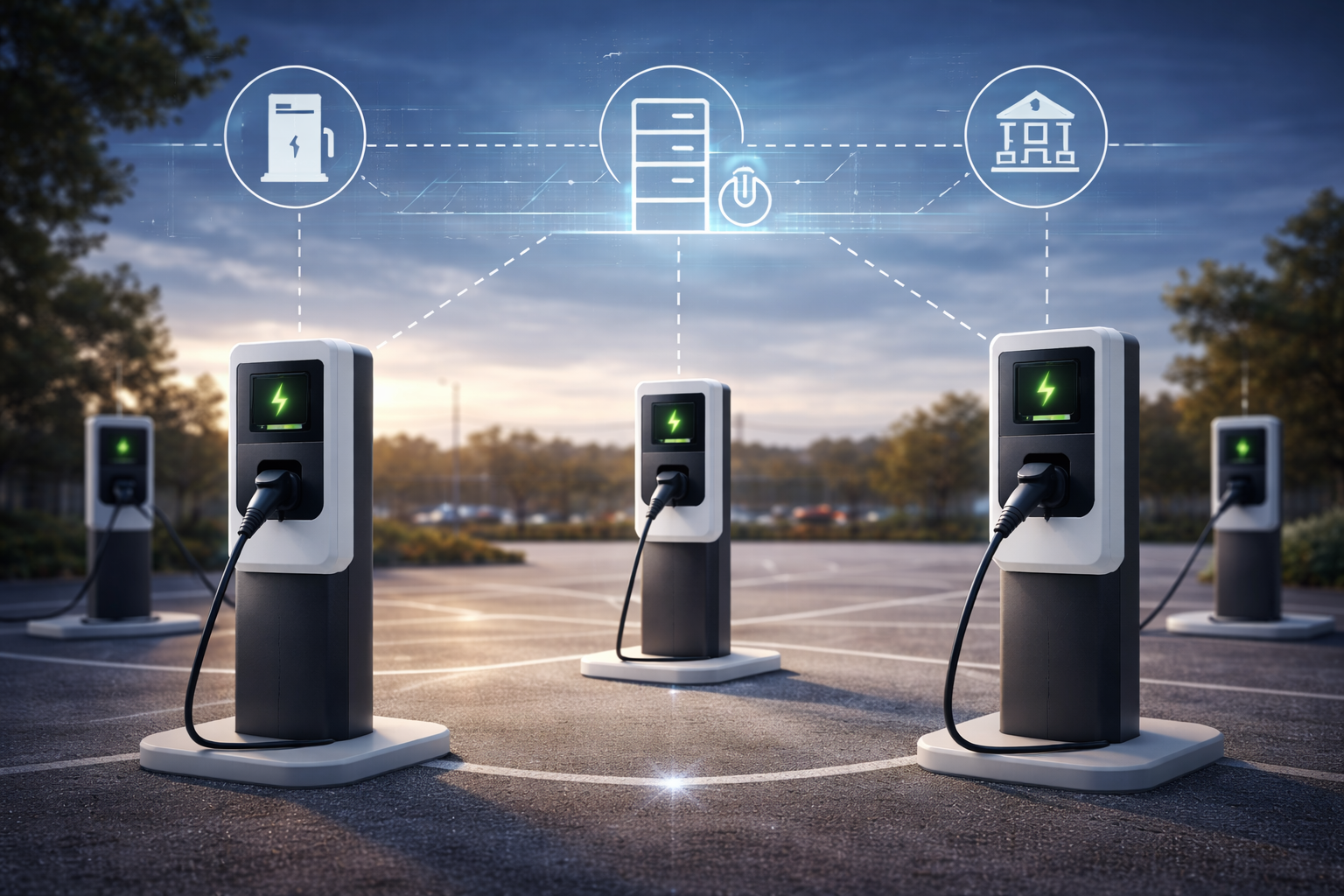
EV Charging Network Architecture: How Charging Platforms Power Reliable Infrastructure

Why EV Charging Architecture Matters
EV charging infrastructure is often perceived as a simple interaction between a vehicle and a charger. In reality, modern charging networks rely on a sophisticated software architecture connecting thousands of devices, multiple cloud services, payment systems, and roaming platforms.
Reliable network architecture is critical because charging stations must coordinate several functions simultaneously:
• device monitoring and diagnostics
• driver authentication
• charging session management
• payment processing
• energy measurement and billing
• firmware updates and device management
Without a well-designed architecture, charging networks can experience reliability issues, operational complexity, and vendor lock-in.
As EV adoption accelerates globally, scalable charging software platforms are becoming the backbone of charging infrastructure.
Learn more about S44 Energy’s work building charging platforms and open charging infrastructure.
The Core Components of a Charging Network
A typical EV charging network includes several interconnected software and hardware layers.
Charging Stations (EVSE)
Electric Vehicle Supply Equipment (EVSE), commonly referred to as chargers, are the physical devices delivering electricity to vehicles.
Modern chargers include onboard controllers capable of communicating with backend software using open protocols such as Open Charge Point Protocol (OCPP).
According to the Open Charge Alliance, OCPP is the global standard used by most commercial charging infrastructure to enable communication between chargers and backend systems.
These chargers continuously transmit data such as:
• operational status
• connector availability
• charging session data
• energy consumption metrics
• fault and diagnostic information
Charging Station Management Systems (CSMS)
At the center of the network architecture sits the Charging Station Management System (CSMS). This software platform acts as the operational brain of the charging network.
A CSMS performs several key functions:
• managing charger connectivity
• authenticating drivers
• starting and stopping charging sessions
• monitoring charger health
• collecting usage and billing data
• performing firmware updates
• enabling smart charging and energy management
Modern CSMS platforms are typically built on cloud-native infrastructure to support large fleets of chargers distributed across multiple geographic regions.
S44 Energy’s open-source CSMS platform (and a Linux Foundation Energy project) CitrineOS is designed to support interoperable charging infrastructure built on open standards such as OCPP 2.0.1, while maintaining compatibility with legacy OCPP 1.6 chargers.
Because CitrineOS is open-source and modular, operators can deploy it in a variety of environments including private cloud, hybrid infrastructure, or fully managed services.
Communication Protocols and Interoperability
Charging networks rely on several communication protocols that enable interoperability between devices and systems.
OCPP
- OCPP (Open Charge Point Protocol) governs communication between charging stations and the backend platform.
- OCPP allows operators to manage chargers remotely and collect operational data without relying on proprietary integrations.
OCPI
- While OCPP governs device communication, OCPI (Open Charge Point Interface) enables communication between charging networks.
- OCPI enables roaming functionality, allowing drivers to access chargers across different networks using a single account.
ISO 15118
- Another key standard is ISO 15118, which enables communication between vehicles and charging stations.
- ISO 15118 supports Plug & Charge authentication, allowing vehicles to automatically authenticate with compatible chargers.
- ISO overview
Together, these protocols enable the EV charging ecosystem to function as an interoperable network rather than isolated proprietary systems.
Payments and Billing Infrastructure
EV charging payments add additional complexity to network architecture.
Unlike retail transactions where the purchase price is known upfront, charging sessions involve dynamic variables including:
• energy consumption (kWh)
• charging duration
• pricing models
• idle fees
• time-of-use electricity pricing
Because of this complexity, charging networks often rely on payment gateways, billing systems, and roaming settlement services to manage transactions.
Industry research from McKinsey & Company highlights that charging network operators must integrate multiple payment mechanisms to support a seamless driver experience.
Modern charging platforms often support:
• mobile app payments
• RFID authentication
• credit card readers
• roaming partner billing
• fleet account management
S44 Energy’s commercial platform TopazEV, built on the CitrineOS foundation, enables operators to integrate payment systems and roaming infrastructure while maintaining control over their network architecture.
Data Infrastructure and Telemetry
Charging networks generate significant operational data that must be processed and analyzed.
Large networks may generate millions of telemetry events per day from charger status updates, charging sessions, diagnostics, and energy measurements.
This data is essential for:
• charger uptime monitoring
• predictive maintenance
• network performance analytics
• billing reconciliation
• infrastructure planning
According to the International Energy Agency (IEA), global public charging infrastructure exceeded 4 million chargers in 2023, highlighting the scale of data and infrastructure management required.
Modern charging platforms increasingly incorporate data analytics and machine learning to identify patterns that indicate potential hardware or connectivity issues before they impact driver experience.
Why Architecture Flexibility Matters
Many early EV charging networks relied on proprietary SaaS platforms where the software provider controlled the entire system architecture.
While this simplified early deployments, it often limited flexibility for network operators as infrastructure scaled.
Operators increasingly seek platforms that allow them to:
• integrate multiple charger vendors
• support open communication standards
• customize payment systems
• control network data and analytics
• avoid vendor lock-in
Platforms built on open standards and modular architecture allow operators to adapt as charging hardware, software standards, and regulatory environments evolve.
S44 Energy’s platforms, including CitrineOS and TopazEV, are designed to support this flexible architecture, allowing operators to scale infrastructure while maintaining interoperability across hardware vendors and software systems.
Building Charging Networks for the Future
As EV adoption continues to accelerate worldwide, charging infrastructure must evolve from small pilot deployments into highly reliable digital infrastructure networks.
A robust charging architecture requires:
• interoperable communication protocols
• scalable backend platforms
• secure payment infrastructure
• reliable telemetry and data management
• flexible integration with new technologies
Charging networks built on open standards and modular software platforms are better positioned to adapt to the evolving EV ecosystem.