How EV Charging Payments Work
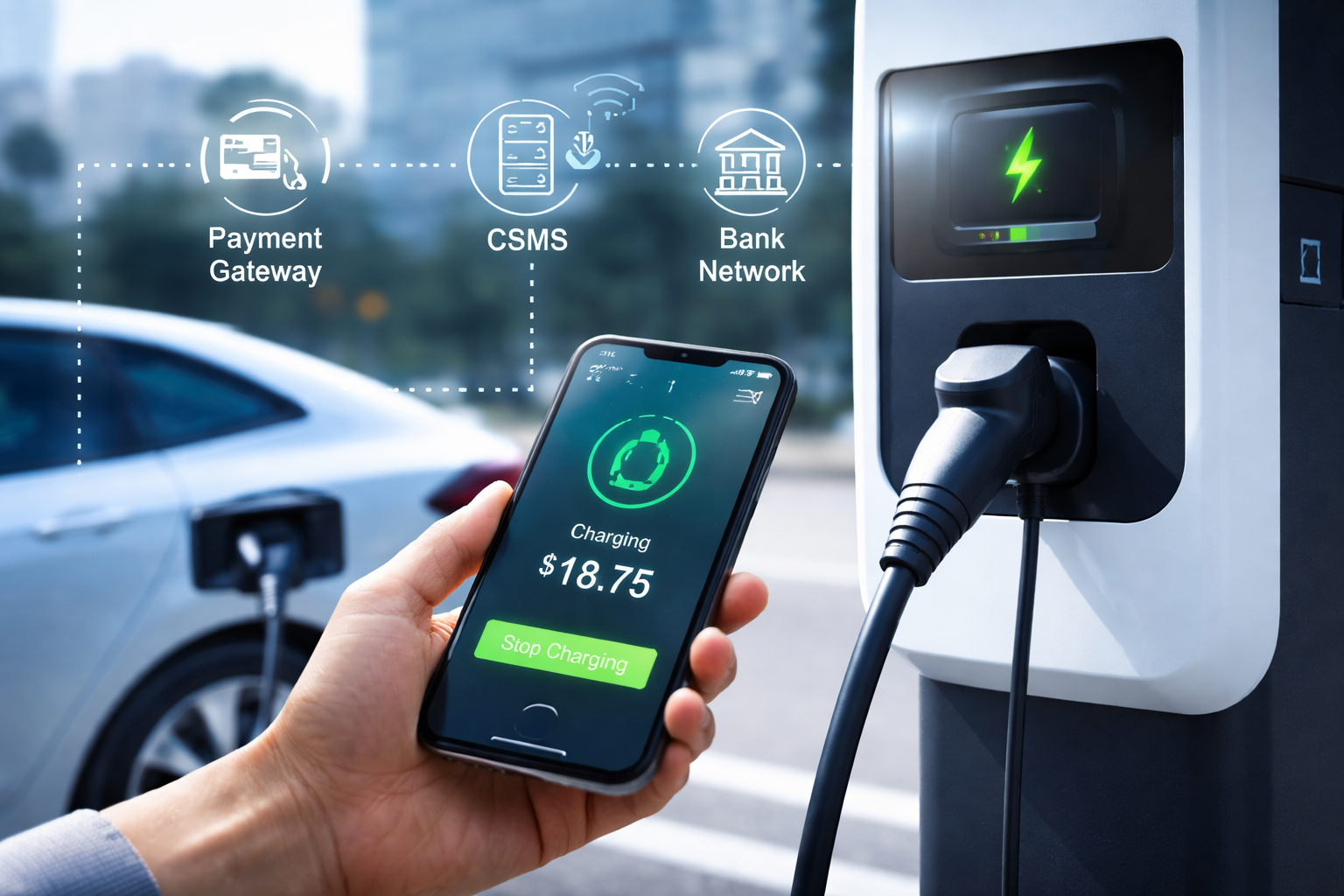
EV charging payments may appear simple from the driver’s perspective - plug in, tap a card, and start charging. Behind the scenes, however, the transaction process is far more complex than a typical retail purchase. Unlike retail transactions that happen at a single moment in time, EV charging sessions can unfold over several minutes or hours and require coordination between chargers, backend software, payment gateways, roaming systems, and user applications.
That complexity matters because payment reliability is inseparable from charger reliability. A charger can be online and fully functional, but a failed authorization, roaming mismatch, or billing error can still prevent a successful session. As S44 Energy notes in EV Charging Is Becoming a Payments Network, charging is increasingly behaving like a financial workflow rather than a simple utility transaction.
For operators, utilities, fleets, and charger manufacturers, this means payment architecture deserves the same attention as hardware selection and network uptime. Modern charging platforms need to manage variable energy consumption, dynamic pricing, identity, and settlement while maintaining a smooth driver experience.
Why EV charging payments are different
A traditional card transaction usually has three simple characteristics: the merchant is known, the price is known, and the transaction ends in seconds. EV charging breaks all three assumptions. The final cost is often unknown at the beginning of the session, the amount of energy delivered can vary based on vehicle behavior and site conditions, and the session may depend on communication across multiple parties before settlement is complete.
This is one reason open, interoperable backend architecture matters. S44 Energy’s TopazEV platform, built on the open-source CitrineOS foundation, is designed to give operators and manufacturers more control over these workflows rather than forcing them into rigid, opaque payment stacks.
The charging session lifecycle
A typical charging payment workflow includes several stages. Each one introduces technical and operational dependencies that can affect whether the session succeeds and how revenue is ultimately recognized.
• Driver authentication
• Payment authorization
• Charging session initiation
• Energy delivery
• Pricing calculation
• Transaction settlement
Because the final session price cannot always be known when charging begins, networks typically validate the payment method first, then complete the billing logic after the session ends. This is fundamentally different from a fixed-price purchase and is one of the reasons many off-the-shelf payment models do not map neatly onto charging operations.
Pre-authorization holds
Most charging networks place a temporary pre-authorization hold on the driver’s card before energy delivery begins. In practice, these holds often fall in the $20 to $100 range, depending on the operator, charger type, and geography. The hold helps reduce the risk that energy is delivered but the final transaction cannot be captured.
From an operator’s perspective, pre-authorization is a risk-control mechanism. From a driver’s perspective, it can be confusing if the network does not clearly explain that the hold is temporary. The best charging platforms therefore need to support not only the underlying payment flow, but also transparent user communication and consistent reconciliation after the session closes.
Pricing models are more varied than most merchants expect
Charging networks may bill based on one pricing method or a combination of several. Common models include:
• Energy-based pricing ($/kWh)
• Time-based pricing ($/minute)
• Session fees
• Idle or overstay fees
• Subscription or fleet-based pricing
These models are shaped not only by business strategy, but also by regulation. In some jurisdictions, electricity resale rules affect whether operators can charge directly by the kilowatt-hour. That means the platform’s pricing engine must be flexible enough to adapt to local regulatory requirements without forcing operators into workarounds that distort economics or the driver experience.
S44 Energy has written about adjacent pricing challenges in The dynamic pricing roadblock in EV charging, where pricing, utilization, and operator margin all intersect. Payment architecture and pricing architecture are deeply connected; one cannot be optimized without the other.
The systems behind a single EV charging payment
A charging payment rarely involves just one system. In most deployments, successful transactions depend on several layers working together:
Charging Station Management System (CSMS)
The CSMS coordinates the session lifecycle, charger communication, transaction logic, and business rules. It is the operational brain of the network. If the CSMS is inflexible, operators may struggle to support new pricing models, payment partners, or charger types. For a broader explanation of the software layer behind charging networks, see The Complete Guide to EV Charging Software Platforms (CSMS)
Payment gateway
The payment gateway connects the charging platform to banking rails and card networks. It manages authorization, capture, and settlement. In charging, however, gateways must support session-based logic instead of a simple one-time purchase.
Roaming platform
When a driver charges outside their home network, roaming protocols and settlement services can become part of the payment path. This introduces another layer of identity, reconciliation, and revenue sharing. Interoperability across networks depends heavily on standards such as OCPP and OCPI, which support communication and partner coordination across the charging ecosystem.
Driver authentication layer
Drivers may authenticate through a mobile app, RFID card, contactless terminal, or Plug & Charge certificate. Each method changes how the platform establishes identity, authorizes payment, and records the session. The more fragmented the authentication stack, the more important it becomes to have a backend platform that can orchestrate these paths consistently.
Why SaaS charging platforms often limit payment flexibility
Many SaaS charging platforms bundle payments inside the software stack. That may simplify deployment in the short term, but it often limits merchant control, obscures fee structure, and restricts an operator’s ability to select payment partners or tailor pricing logic. As networks mature, these constraints can quietly erode margins and make it harder to launch differentiated business models.
This is one reason interest in open foundations continues to grow. In EV Charging Needs Open Source, S44 Energy explains why operators increasingly want transparency, interoperability, and the freedom to build on standards rather than remain locked into closed SaaS systems. For payment workflows specifically, open architecture makes it easier to choose partners, evolve business logic, and retain control of economics over time.
Why payment reliability directly affects the driver experience
To drivers, the distinction between a charger failure and a payment failure is largely irrelevant. Both result in a broken experience. That is why networks need to think about payments not as a separate finance function, but as an operational capability that influences uptime, trust, support costs, and repeat usage.
Reliable platforms should make it easier to identify where failures occur, whether in authorization, roaming, communication, or billing logic. They should also support the visibility needed to reduce false declines, improve reconciliation, and create cleaner handoffs between operations, finance, and customer support.
What modern operators should look for
Operators evaluating payment-ready charging software should look for a platform that can:
• Support multiple pricing models without custom workarounds
• Integrate cleanly with gateways, terminals, apps, and fleet billing systems
• Handle charger communication and payment logic in one operational view
• Support open standards and interoperability across hardware and roaming partners
• Provide the flexibility to evolve beyond embedded SaaS payment models
These capabilities are especially important for networks planning to scale internationally, support multiple charger types, or move from pilot deployments to revenue-generating operations.
Closing perspective
EV charging payments are not a minor add-on to infrastructure; they are part of the core operating model. The networks that succeed will be the ones that treat payment architecture as strategically as charger selection, software reliability, and site design. Open, adaptable platforms give operators more control over pricing, settlement, and user experience - and ultimately put them in a stronger position to scale.
To learn more about S44 Energy’s work in open charging infrastructure, explore S44 Energy, TopazEV, CitrineOS, and EV Charging Is Becoming a Payments Network for a deeper look at how open foundations and modern charging software are reshaping payment and operations across the industry.